
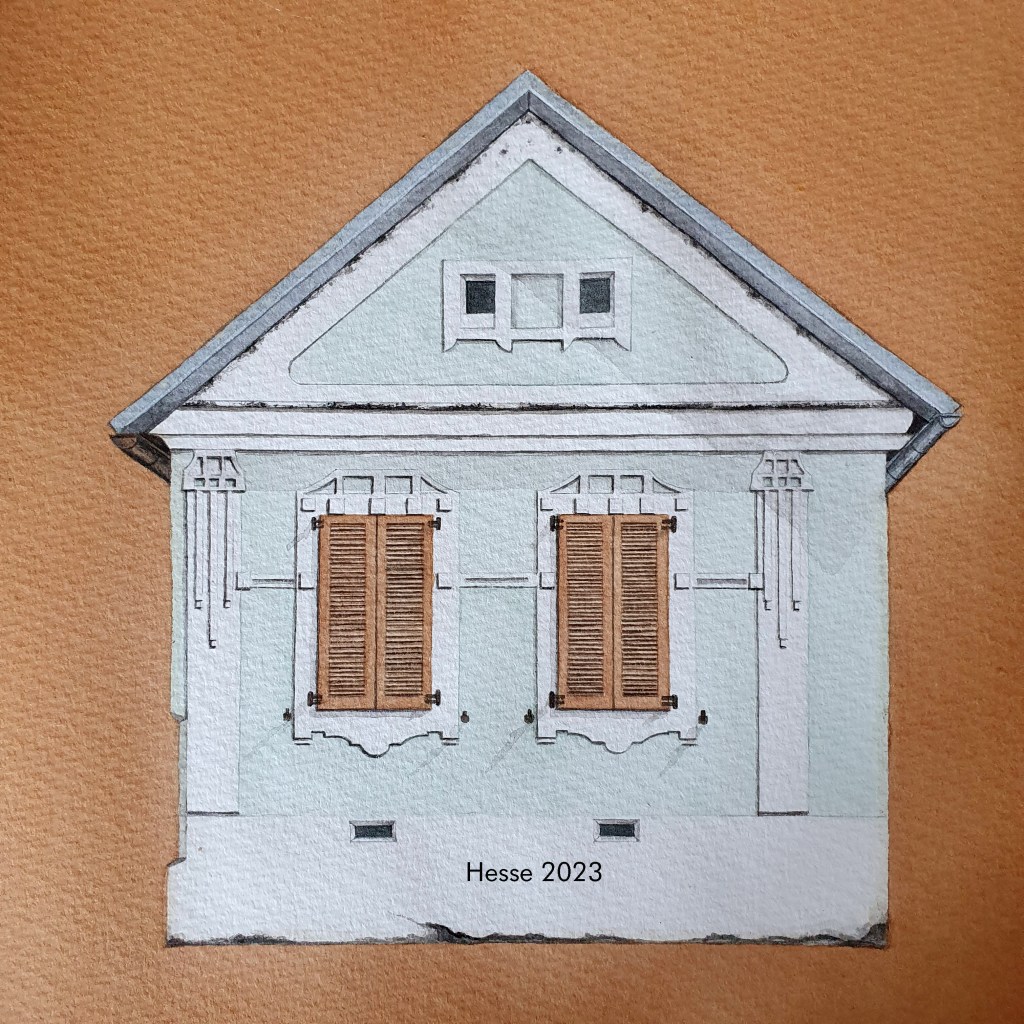
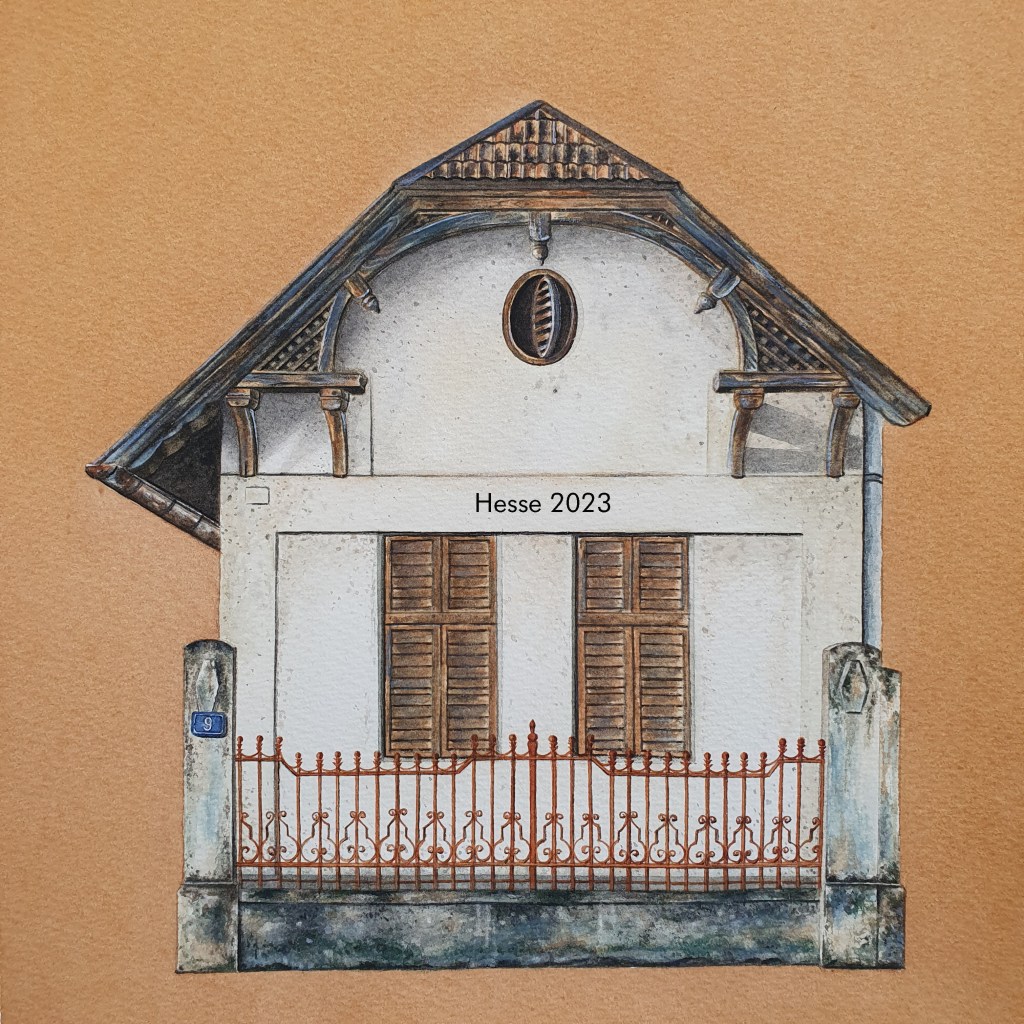
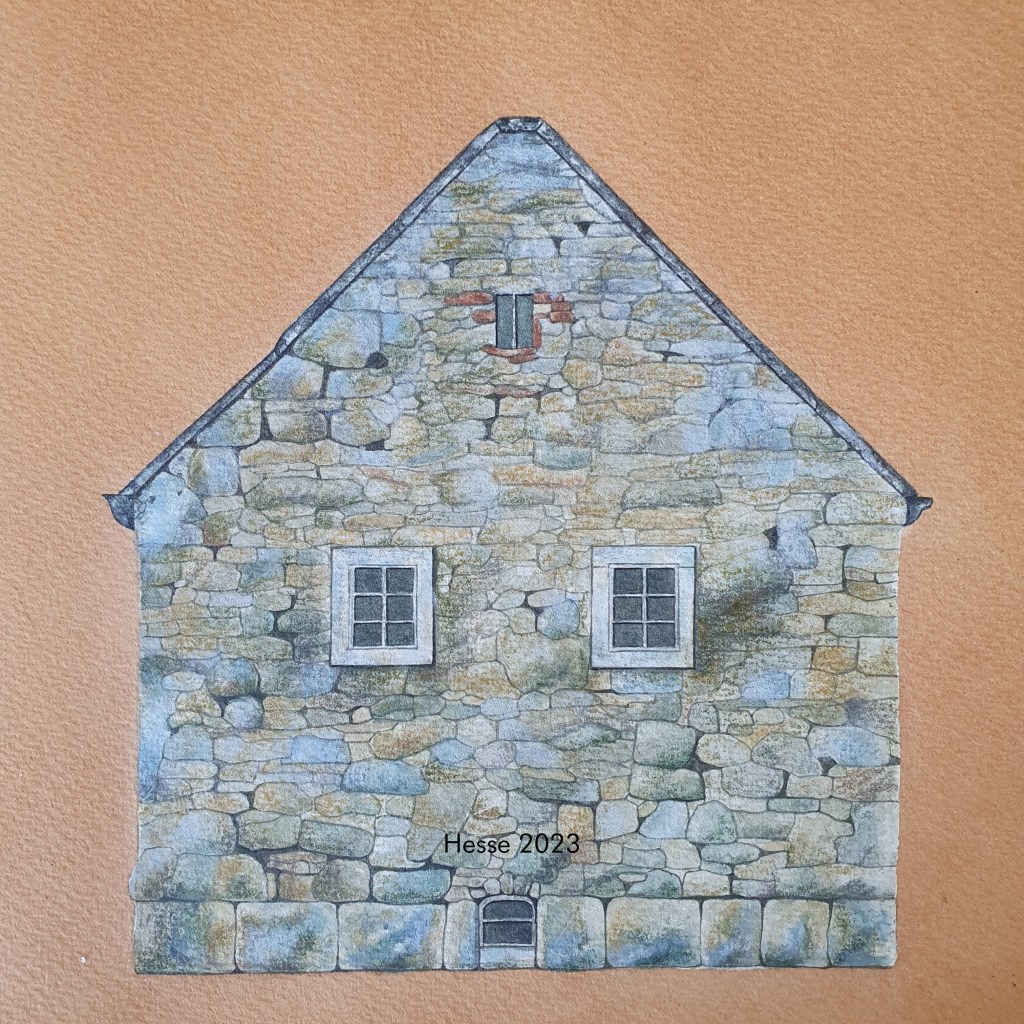
In the aftermath of my exhibition “Streckhoefe fuer Kinder” in June 2023, I decided working on a 12 piece series of watercolour paintings showing the gable end façade of a building type which is commonly found in village structures (cf. “Strassendoerfer”) in the Danube area, Burgenland and Lower Austria: the Streckhof.
A total of 9 to 10 Klafter long and 4 ½ Klafter wide: this was prescribed by the Vienna Court Chancellery when a planned resettlement took place after the Turkish wars (cf. Galician Domains Act 1787). A Klafter used under Maria Theresia corresponded to 6 Fuss (= 1,896 m). Most remaining Streckhoefe today are little more than 5 meters wide, but in some cases up to 100m long due to extensions to the house on typically elongated plots.
The Streckhof in its original form is a planned agricultural building, consisting of living quarters, stables, barns and sheds, each built one after the other. Some have arcades, too. The gable end of the house usually faces the village street. But there are variations as well (cf. “Hakenhof”). The narrow courtyard between two Streckhoefe is delimited by the wall of the neighbouring courtyard.
Where poverty often reigned in earlier times and people were even ashamed of their small houses, and the building materials, many a Streckhof today represents a small treasure trove of materials: clay, wood, stone, brick, and lime plaster.
In contemporary architecture, this type of construction is rarely used. And many of the remaining Streckhoefe have been altered, are derelict or are being demolished.
Whether a Streckhof faces the street with the gable end or lengthswise, one usually notices when being in the presence of a Streckhof because of its human scale.
My series of 12 small-format watercolour paintings is a contemporary document. The selection shows still standing houses in the Austrian Burgenland. Some are renovated, some in a poorly state, facing an unknown future.
All images © Hesse 2023


Tol
LikeLike