Angaben zur Onlinestreitbeilegung: Verbraucher haben die Möglichkeit, Beschwerden an die Online-Streitbeilegungsplattform der EU zu richten. Sie können allfällige Beschwerden auch an die oben angeführte E-Mail Adresse richten.
Alle Bilder und Texte dieser Website sind urheberrechtlich geschützt. Eine Vervielfältigung dieser Daten, einschließlich dem Abspeichern auf optischen und elektronischen Datenträgern, ist ausschließlich in einem vertraglich geregelten Rahmen oder nach vorheriger Absprache mit Carola Hesse möglich.
INHALTE DER WEBSITE
Diese Website wird ständig weiterentwickelt. Dabei besteht ein ausdrückliches Bemühen um die Bereitstellung korrekter und aktueller Informationen. Dennoch kann keine Haftung für die vollständige Korrektheit und Aktualität sämtlicher Inhalte der Website übernommen werden. Diese Website enthält außerdem Links zu anderen Websites, für deren Inhalte keine Verantwortung vorliegt. Ebenfalls besteht keine Haftung für verlinkte Seiten (ECG §17). Sollten ihnen Fehler auf dieser Website auffallen, so nehmen sie bitte Kontakt auf.
At the continents emerging from the North Sea, the coastline is nothing constant. The sea and its tide have a major impact on its appearance and expanse. As a child I’ve spent a lot of time at the shores of the North Sea and sometimes the Baltic Sea as well. There was always something new to discover, something new to learn. We have a saying over there: the sea gives, the sea takes.
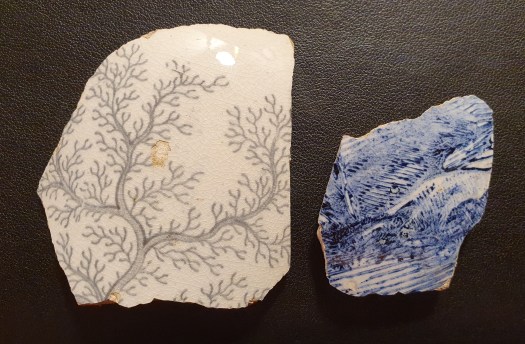
My first real interest in porcelain awoke just there, during one special summer holiday at the Baltic Sea. There I found at least fifty small pottery sherds with all different types of patterns and colours that had been washed ashore. Some where thicker, some thin and delicate. At that tender age I hardly knew anything about pottery really, but it seemed obvious that some sherds were fairly old, and others younger. And also, they were made of different clay materials. Unfortunately, those pieces got lost over time. But here and there I still find single sherds.
The history of pottery — earthenware in particular — dates back to the Neolithic period. Perhaps even earlier. Porcelain however, was made of a material that was unknown in Europe until the 14th Century. It was the Chinese who invented it.
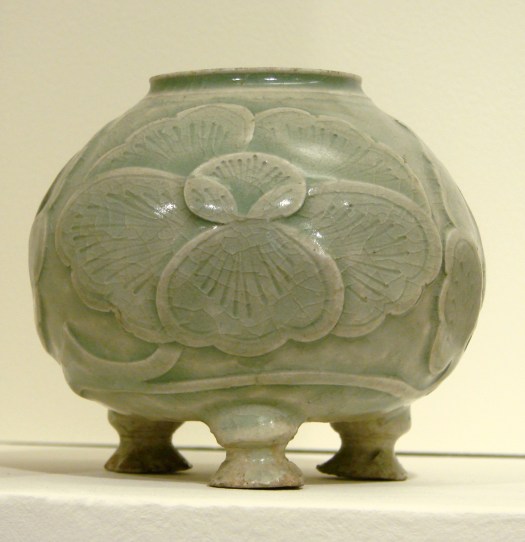
The first ancient ceramic kiln sites in China were located in the Zhejiang Province during the Shang Dynasty (1766-1027 BCE). It became a concentrated area for the production of celadon — an earthenware material with an opague blue-ish, blue-green or jade green plant-ash glazing. From the 9th to the 16th century Yaozhou ware (Northern Celadon) and Longquan celadon ware (Southern Celadon) were supplied to the imperial court, to domestic folk life, and also became important products for export.
Painted pottery sherds (HESSE 2021)Yaozhou ware (WIKIPEDIA)
When it comes to Chinese porcelain, there is one particular town that, by the 14th century, had become the largest centre of porcelain production in the world, and remains so until today. This town is called Jingdezhen.
Originally, the ceramic production in Jingdezhen started in the Tang Dynasty (618-907 AD). Later, in the Song Dynasty (960-1279 AD) it witnessed a rapid increase in production. It was Emperor Zhenzong who decreed in 1004 AD, that Jingdezhen should be the production site for all imperial ceramics in the country, and also renamed the town according to his era name (Jingde).
The area was particulary rich in natural resources, but the clay soon became depleted through the excessive production during this period. Luckily, around the 10th century (Yung Dynasty), a new type of clay was discovered. Following the same steps in the line of production, but this time with a different locally mined rock (kaolinised granite), it became possible to produce a much purer whiteness. The essential ingredient that made the white material possible was kaolin. It can be found all over the world, but around Jingdezhen, the kaolin variety is particulary fine. And it was because of this high density, that a much harder porcelain could be produced, while at the same time being shiny and translucent. By then, Chinese trade had spread as far as Persia where cobalt was obtained. The use of cobalt blue underglaze eventually led to the recognizable Chinese blue and white style.
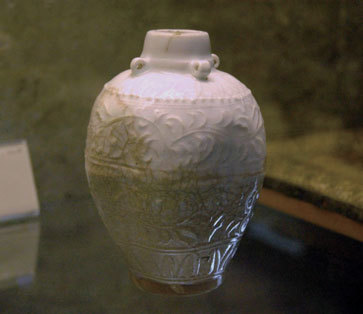
Later on, it was Marco Polo who first brought porcelain from China to Europe. Although, there must have certainly been other merchants who traded with China. And yet, the stories of Marco Polo is the only known historical account. A porcelain object, the so called Marco Polo Jar, a Qingbai Porcelain Jar, might be the only artefact that is actually linked to him. It is suggested that it was brought to Venice in 1295 AD and is housed in the Treasury of San Marco in Venice today.
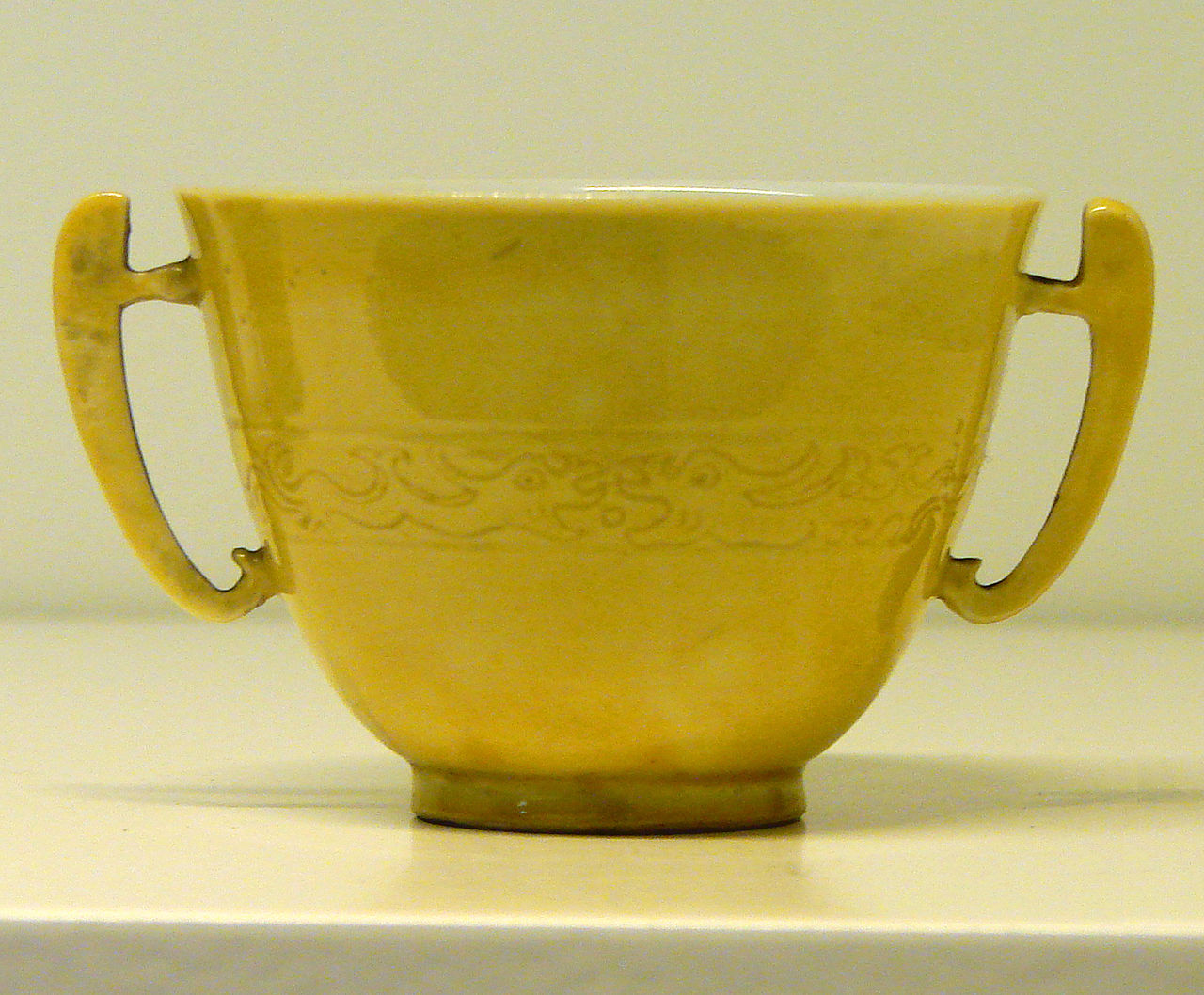
‘Marco Polo jar’ (LIN MEICUN, RESEARCHGATE)Kraak ware, Jingdezhen (WIKIPEDIA)Cup with imperial yellow glazing (WIKIWAND)Delft ware, lidded vase, around 1800 (not officially dated) (HESSE 2021)
Not long after that, the Portuguese established trade routes to the Far East and began commercial trade with Asia. Porcelain however, was only a small part of the trade. The cargos were full of goods such as tea, spices, silks, or ivory.
In 1603 the Dutch East India Company seized a Portuguese merchant ship called Santa Catarina. The Dutch referred to the large amount of stolen blue and white porcelain as Kraakporcelain which was due to the type of the ship — a carrack. Subsequently, it is estimated that more than three Million porcelain pieces were shipped to Europe in little over fifty years — mainly by the Dutch. This Chinese export ware is reffered to as Kraak ware. It was often painted with variations of traditional motifs, such as stylized flowers and Buddhist emblems. The most characteristical decoration was the division into radial panels.
When Europeans first layed eyes on Chinese porcelain, they thought it to be much finer and superior to anything they could fashion — which was at that time stonewares and earthenwares, and those were rather rough in comparison. So the idea that utilitarian objects could also be pieces of art was revolutionary, and this would have a profound influence on our aesthetics. To many however, this was just an opportunity for conspicuous consumption. The English writer Daniel Dafoe even wrote, that chinamania would destroy whole families. Interestingly, there are paralles in this regard to 17th century tulipmania in the Netherlands.
Over time, the demand for familiar, utilitarian forms from Europe increased. Meanwhile in Beijings Forbidden City, during the reign of Emperor Kangxi(1654-1722 AD), a ware so fine and so exquisit was potted that could make the most export wares look lumpen. The court even had their own colour palette. The imperial yellow glaze for instance was used as early as the Xuande period (1426-1435 AD).
There where implications through the trade for both sides — China and Europe. Many of the forms that the Europeans ordered were unknown to the Chinese, candlesticks for instance. Also, the Chinese potters had to decorate the porcelain with images they didn’t understand. Most of them had never even seen Europeans but all of a sudden had to depict their likenesses. This led to Europeans showing Oriental features or wrongly spelled Latin inscriptions on the porcelain. Another aspect was that European artists had tried to create an illusion of depths in their paintings since the Middle Ages whereas traditional symbolism was more important to the Chinese in their decorations.
In the 16th century the Europeans still hadn’t discovered the secret of Chinese porcelain, but the race was on. In 1575 a Medici factory had been set up in order to replicate it, but couldn’t reach the Chinese porcelain qualities in their replicas. Then, in 1708, it was Augustus II, Elector of Saxony and King of Poland — or rather his obsession and money — who finally brought the white and translucent porcelain production to Europe. In 1710, he created the Royal Saxon Porcelain Manufactory in Meissen. There, only three people knew the secret formula called arcanum. The secret was so precious, that other Northern European rulers tried everything from bribary to kidnapping to get a hold on it, and eventually succeeded.
Chinese porcelain, decorated only with blue pigments under the glaze, dominated the export trade until the very end of the seventeenth century. Today, Jingdezhen’s traditional technique of producing handmade porcelain has become a part of China’s national intangible cultural heritage.
Meicun, L., and Zhang, R.: A Chinese Porcelain Jar Associated with Marco Polo. A Discussion from an Archaeological Perspective. European Journal of Archaeology, 21(1), 39-56 (2018).
Munger, Jeffrey, and Alice Cooney Frelinghuysen: East and West: Chinese Export Porcelain. In: Heilbrunn Timeline of Art History. New York: The Metropolitan Museum of Art, 2000. https://www.metmuseum.org/toah/hd/ewpor/hd_ewpor.htm (06.07.2021).
Shanghai Daily: Jingdezhen, the home of porcelain (2017) https://archive.shine.cn/sunday../now-and-then/Jingdezhen-the-home-of-porcelain/shdaily.shtml (06.07.2021).
Tharp, Lars: Treasures of Chinese Porcelain. BBC Four Documentary (2011).
Vainker, Shelag: Chinese Pottery and Porcelain: From Prehistory to the Present. London: British Museum Press (1991).
DELIVERY INFORMATIONS I VERSANDINFORMATIONEN For postage within Austria, your shipping costs is a fixed rate of Euro 6,00 for shipping with a tracking number and packaging. If you wish your chosen items to be shipped to other EU-Member States or to countries outside the EU, please contact me for further information. Please note that international deliveries may be subject to import duties, taxes and fees. As for the moment I can only offer you prepayment (via bank transfer) as payment method.
RETURNS POLICY (EU-Member States only) I RÜCKGABERECHT You can exchange or return any ordered goods from my website without giving a reason within 14 days after receiving it. Please note that in order to being able to refund the full purchase price, the products must not show any damage. This policy is only valid in EU-Member States.




 Carola Hesse